
Read Webster County’s Current Owner Card
A check of the assessed owner starts at the Webster County PVA. The free basic search does the job. It returns the assessed name fast. Basic ownership and value details come with it. But enhanced transfer history, photos, sketches, improvements, and sales filters remain subscription features. Read the free card as a first pass, not the full owner-of-record file.
| Assessed owner | The person or entity associated with the current assessment record |
|---|---|
| Parcel ID | The exact key used to reconcile PVA, GIS, tax, and deed references |
| Site address | The land location, which can differ from the postal label or owner mailing address |
| Mailing address | The destination used for owner correspondence or assessment notices |
| Deed reference | A book, page, or displayed link that should lead to the recorded instrument |
| Class and acreage | Assessment and mapping facts that help rule out the wrong parcel |
An owner-of-record card is not an occupant list. Match the parcel ID and land details first. A duplicate street address, a rural route, or a city mailing label can otherwise point you to the wrong Webster County current owner.
Confirm Webster County’s Owner Now
A strong owner check uses two records. The county clerk lists deeds from 1860 Book 1 through current, and online viewing is free. Match the PVA card against the newest deed. Backscanning and indexing continue, so a blank web result never ends a Webster County property search.
- Save the PVA owner exactly as displayed, including initials, suffixes, joint names, or an entity ending.
- Carry the parcel ID, deed reference, address, and map keys to the clerk’s deed index.
- Open the newest transfer and compare its grantee and legal description with the PVA parcel.
- Look for a later correction, court order, commissioner’s deed, estate instrument, or parcel split before closing the check.
- Owner of record
- The party named by the official record being used at that point in time.
- Vesting
- The wording that identifies who received the interest and how it is held.
- Registered agent
- An entity’s designated legal contact, not automatically its landowner or manager.
- Legal description
- The deed language defining the land conveyed, which a street address cannot replace.
Newest Webster County Deed Controls
The newest valid recorded instrument is the key confirmation source. Read the grantee clause and the source-of-title recital. Check the execution and recording dates. Note the book and page, and the full legal description. A GIS deed reference is only a pointer. It never substitutes for reading the deed itself.
Not every transfer looks like a sale. A correction deed fixes names or descriptions. A commissioner's deed can follow litigation. An affidavit of descent, a will, a probate order, a merger, or a trust transfer can also explain a change of assessed owner. None of these follow a buyer-and-seller pattern. Search related names and instrument types when the current owner trail is not clean.
The full owner-finding sequence lives on the Webster County property owner page. This check stays focused on the current record.
Why Webster County Owner Records Lag
The PVA assesses Webster County property annually and physically reviews it on a four-year cycle. Its FAQ tells owners seeking a name change to supply the recorded deed. That step explains the lag. A recent grantee can appear in the clerk's index. The assessment roll or the GIS NAME field may catch up later.
Label your sources. Write "PVA displays" or "clerk's index lists" rather than collapsing everything into one owner-of-record claim. Conflicts deserve a call. Ask the PVA whether a transfer update is pending. Ask the clerk whether a later instrument was recorded.
Cross-Check Webster County Owner Fields
The official Webster parcel layer holds many fields. They include PARCEL_ID, PIDN, MUID, NAME, and DEED values. It also lists address, map, block, parcel, account, acreage, class, and district values. Preserve leading zeroes and punctuation. Those details separate two tracts under one owner, or two owners with similar names.
GIS names can be stale or truncated. The parcel polygon may also lag behind a split, consolidation, plat, or recorded survey. Use the map to test whether the card describes the intended land. Then return to the deed for title language.
The official layer metadata page shows which parcel attributes the state service exposes.
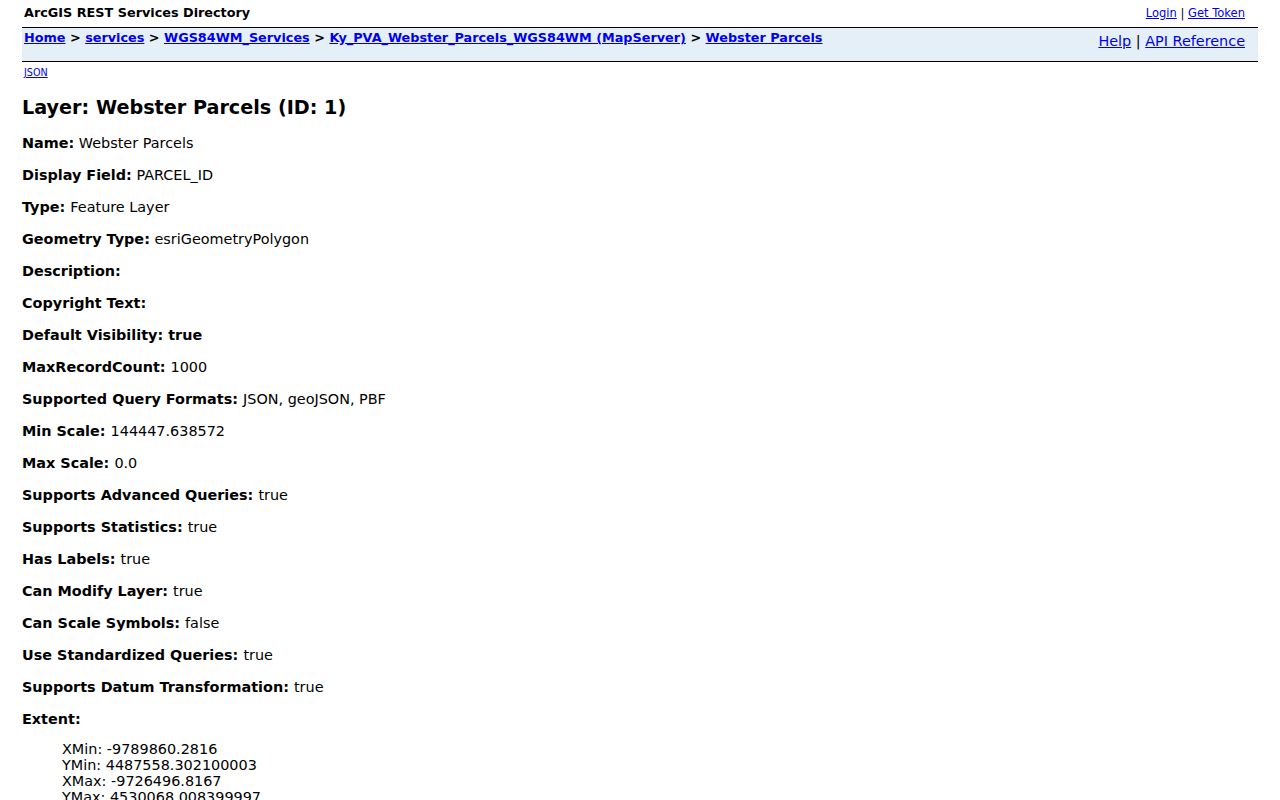
The image supports a field-level cross-check. It does not show a live owner card or prove that an assessed name is current title.
Verify Webster County Entity Ownership
The grantee may be an LLC or corporation. Keep the entity as the owner of record. The Kentucky Secretary of State business search can distinguish it by name or organization ID. It can also pull up the public state profile. A registered agent accepts legal service. That role is not personal ownership.
Trusts and estates follow different paths. The public deed may show only a trust name. For an estate, the clerk's will series, an affidavit of descent, probate documents, or a later deed may explain the current vesting. Webster County wills run from 1860 Book 1 through current. Court indexes are leads only until the filed order or deed is read.
Webster County Address Names Shift
Local address forms shift from one record to the next. KY 120 through Providence also appears as West Main, East Main, and Westerfield. KY 132 shows as Main and Lisman through Clay. It shows as Leeper through Dixon. It also appears as Mill and Church through Sebree. A deed can use a route while a PVA card uses a street name.
Search both versions. Retain the original display as well. Treat CITY and ZIP fields as postal or assessment geography. Check an official city boundary before relying on them. A mailing address alone proves no city limits.
Check Webster County Owners Offline
Phone works when the online trail goes cold. Call the Webster County Clerk at 270-639-7006 or the PVA at 270-639-7016. The clerk's recording counter sits at 25 US Highway 41-A South in Dixon. It is open Monday through Friday from 8:00 a.m. to 4:00 p.m. A visit in person lets you ask by parcel ID, deed reference, exact party name, or date range. That often speeds the search. Written requests work too. Identify the records you want. State who you are. Say how you prefer a reply. The county accepts email, mail, fax, or hand delivery. The records custodian answers within five business days. For older deed records, KDLA microfilm covers 1860 through 2016.
Note: Call before mailing because the clerk’s official pages display two different highway-direction forms for the Dixon street address.
Use Webster County Owner Data Lawfully
A current owner's mailing address opens a lawful door for a purchase inquiry or boundary question. It also serves easement issues and estate matters. It does not prove anyone lives there. Keep any contact brief, clear, and tied to the property issue itself. Kentucky Safe at Home offers another layer worth knowing. The program gives qualified participants address substitution and mail forwarding. Official guidance notes that real-estate holdings stay public under it. Even so, share as little personal data as possible and respect each person's safety.
Current record, limited conclusion. Verify the assessed name against the newest deed. Never use owner information to stalk, harass, intimidate, or harm anyone.