
Types of Webster County Deeds
Recording is not approval. The Webster County Clerk accepts an instrument once it meets statutory presentation requirements, but the office does not vouch for every statement inside it. That job falls to the reader. Read the granting clause, the parties, the consideration, the legal description, the source-of-title reference, the signatures, the acknowledgment, and the recording stamp. Kentucky deed labels describe a transaction, yet the full language controls what interest actually passed.
| Deed Type | What It Does | Common Use |
|---|---|---|
| General warranty deed | Conveys the stated interest with broad title covenants | Conventional arm's-length transfer |
| Quitclaim deed | Transfers only the interest the grantor may hold | Family transfer or title cleanup |
| Executor or fiduciary deed | Conveys through estate or authorized fiduciary action | Probate-related transfer |
| Commissioner's deed | Reflects a court-authorized conveyance | Judicial sale or partition |
| Correction deed | Corrects identified terms in an earlier instrument | Name, description, or drafting correction |
Not every recorded instrument conveys ownership. A mortgage or deed of trust only secures an obligation, and releases, assignments, easements, restrictions, fixture filings, and liens each sit in their own series. Search those series directly. A deed record is one event in a longer chain, so treat it that way when you build a title picture in Webster County.
Webster Deed Index Coverage
The clerk lists deed records from 1860 Book 1 forward. Online access began August 1, 2010, and the office notes that backscanning and indexing continue. The published span is a series range. It is not a promise that every historical image is searchable from home.
Related series start at different points. Mortgages run from 1975. Encumbrances run from 1974. Miscellaneous records run from 1952 Book 42. Fixture filings run from October 1994. Wills begin at 1860 Book 1. Plats are posted for 1962 through April 22, 2021. A title question can cross several of these cutoffs. A no-result in the deed index alone proves little.
The clerk's online-record guide displays both its coverage and its scanning caveat.
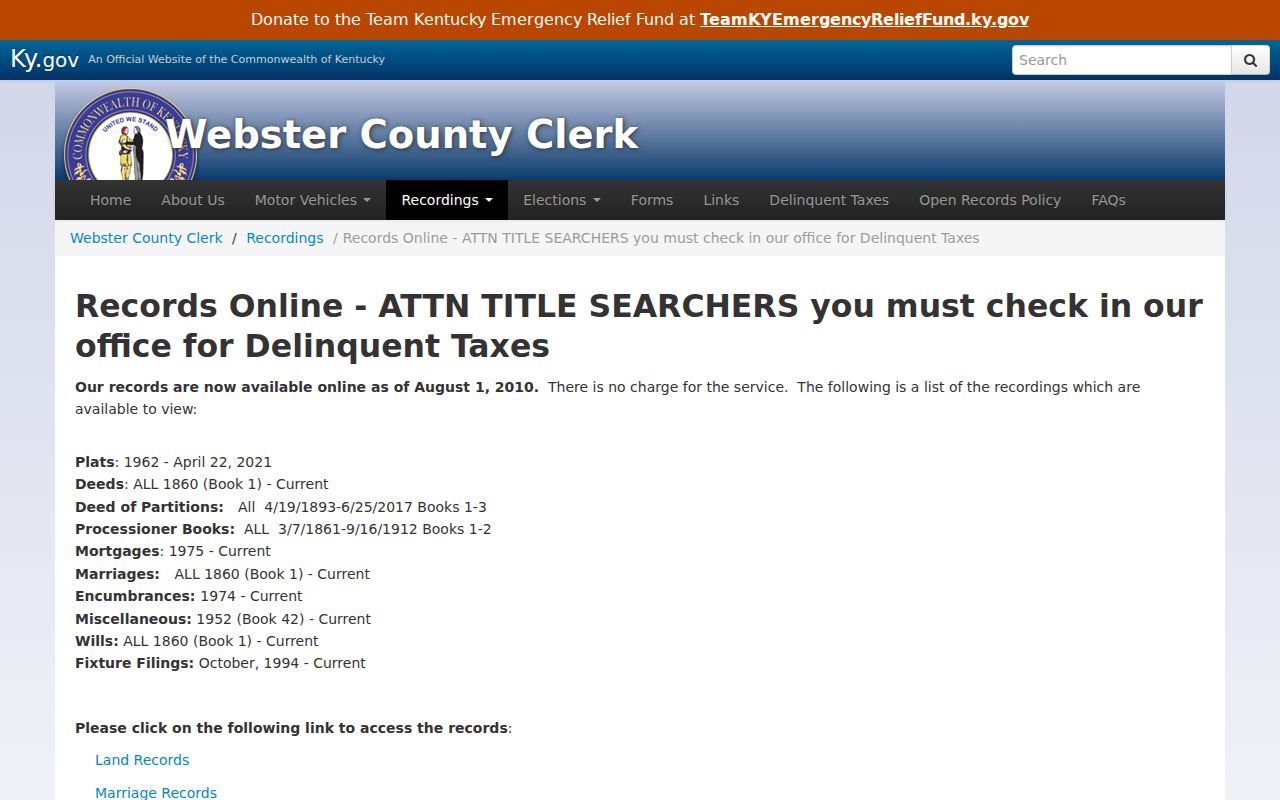
The capture is a useful series checklist before an in-office or written follow-up.
Search Fields for Webster Deeds
The county landing page links to record categories rather than one universal form. Expect to work with party name and role, document type or series, date range, book, page, and image indicator. The linked index exposes the image indicator. Search each relevant series. Keep the exact result label you used. Series names matter when you trace a chain of title.
| Field or Filter | How to Use It | Why It Matters |
|---|---|---|
| Grantor | Search the transferring party | Finds sales and other outgoing interests |
| Grantee | Search the receiving party | Locates an acquisition deed |
| Date range | Bracket the likely recording period | Reduces same-name results |
| Book and page | Enter a known recording reference | Targets the specific indexed instrument |
| Series or type | Repeat in deeds, mortgages, liens, releases, plats, and miscellaneous | Prevents an all-record search from hiding a category gap |
A dynamic search page may expose more fields than the labels above. Note them when you use them. And never assume an image exists just because an index entry appears.
Follow Webster Grantor-Grantee Entries
A chain starts with one deed you already know affects the parcel. The PVA can supply an assessed owner plus a book and page clue. The actual deed holds the legal description. That description confirms whether the instrument concerns the same land. From there, move backward through Webster County deed records one acquisition at a time.
- Find the present assessed owner's acquisition deed with that party as grantee.
- Read the full deed for its grantor, source of title, book/page, and legal description.
- Search that grantor as a grantee during the earlier period.
- Repeat while comparing each tract description, reservation, exception, and plat reference.
- Move to clerk volumes or archival microfilm when the searchable image trail ends.
- Grantor
- The party transferring the stated interest.
- Grantee
- The party receiving that interest.
- Chain of title
- The linked sequence of instruments affecting the same land.
- Book and page
- The clerk's volume reference for retrieving a recorded item.
Names are weak identifiers on their own. Match spouses, trustees, estate capacities, business suffixes, acreage, adjoining owners, road calls, survey references, and the source-of-title clause before you accept a hit.
Read a Webster County Deed
The clerk's deed guidance calls for a properly prepared instrument with parties, a return address, source of title, consideration or transfer-tax information where applicable, a legal description, signatures, an acknowledgment, and a preparation statement. A correction deed carries its own requirements. Easements, leases, land contracts, and deeds of trust remain distinct instruments. Even so, they may cite the same parcel.
The most useful research fields are execution date, recording date, grantor, grantee, consideration, book and page, tax-bill address, legal description, reservations, restrictions, and attached exhibits. Execution and recording dates can differ. A stated consideration may carry exemptions or context. These can keep it from serving as a simple market-value figure, so treat it carefully in any appraisal-style comparison.
Older Webster Deed Books
Webster County was created in 1860 from Henderson, Hopkins, and Union counties. A title chain that crosses county formation may lead into a parent county. The Kentucky Department for Libraries and Archives inventories Webster deed microfilm from 1860 through 2016. It also inventories wills from 1860 through 2002. Land entries and surveys run from 1860 through 1896.
Partition books run from April 19, 1893 through June 25, 2017 in the clerk's listing. Processioner books cover March 7, 1861 through September 16, 1912. They can preserve old boundary-line work. For coal land or a family farm, compare those entries with deed reservations. Also check mineral clauses, road names, creeks, and later plats. Modern parcel geometry may simplify a much older legal story.
Mortgages, Releases, and Liens
After finding a deed, search the owners in the mortgage and encumbrance records. Track the original mortgage or deed of trust through assignments, modifications, partial releases, and satisfactions. A release must match the right obligation and the right tract. Matching borrower and lender names is not enough.
Then check federal and state tax liens, judgment liens, mechanic liens, and inheritance-tax liens. Also check child-support liens, lis pendens, easements, restrictions, fixture filings, and miscellaneous records. CourtNet or the Kentucky Judicial Index may surface a foreclosure, partition, quiet-title, or boundary case. The case index is not the full file, though. Confirm the pleadings, judgment, sale order, and commissioner's report or deed. Also confirm the satisfaction and final disposition. Draw conclusions from the deed record only then.
Webster Recording and Copy Fees
Recording a deed in Webster County costs $50, and a deed correction runs $46. Easements and land contracts each carry a $50 fee. Pages past five add $3 each where that rule applies. Mortgages up to 30 pages cost $80. Adding an assignment raises the total to $126. A mortgage release is $46. So are many assignments, modifications, liens, encumbrances, and lis pendens filings. Certified copies are $5.
These charges apply only to the clerk's recording services. Open-records copies, archive research, and tax-sale costs follow separate schedules. Fees can change. Confirm amounts on the official land-record fee page before you file or order copies.
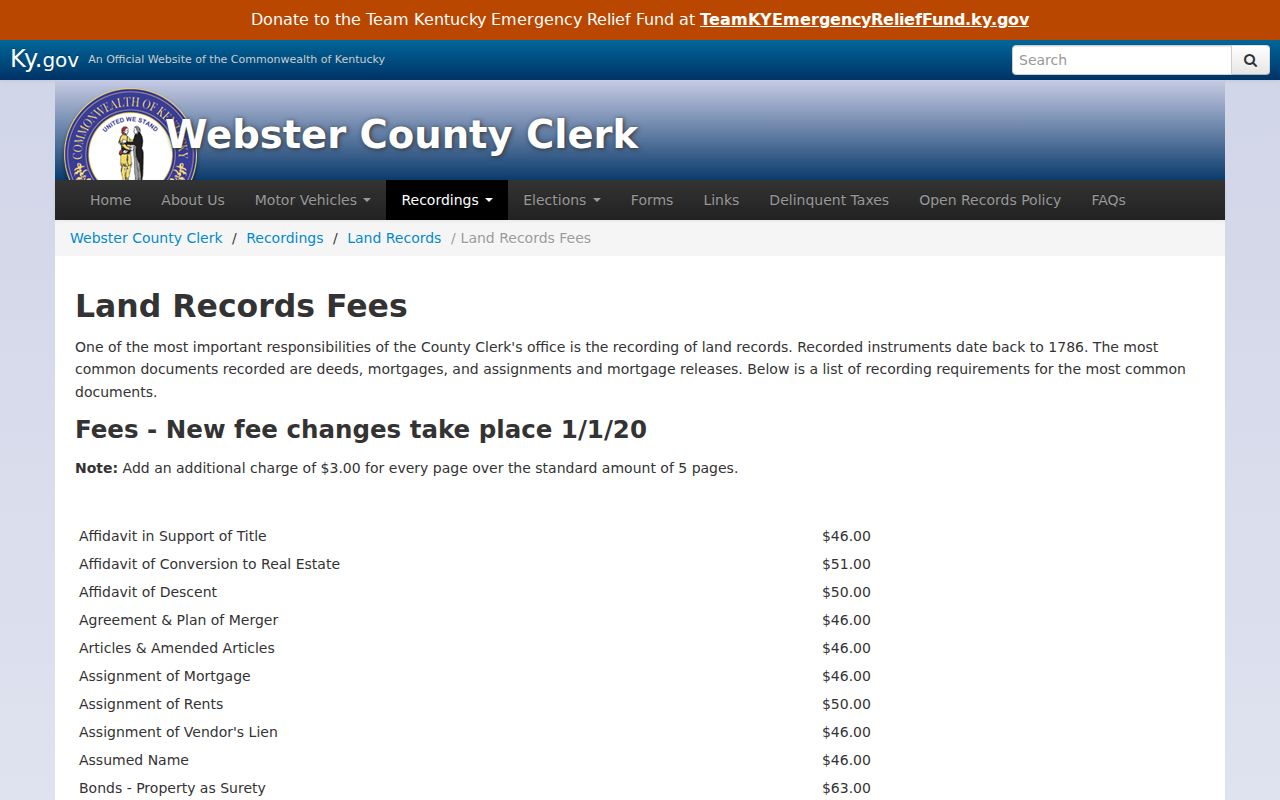
The fee schedule separates what it costs to record a deed from what a plain or certified copy of Webster County deed records will run you.
Webster Title Research Gaps
Webster County offers no official fraud-alert or deed-monitoring signup. Owners worried about a specific filing can search the clerk's current deed records series and ask the recording counter what options exist. A private monitoring service is not the answer here.
An empty result in a deed search has other common explanations. The record may sit in a parent county before 1860, reflect an estate transfer, carry an alternate spelling, or be filed under miscellaneous or encumbrances rather than deeds. Write down the failed query. Then try the reverse index, cite the source of title, and request the identified volume from the clerk or archives.
Plats Behind Webster Deeds
A Webster County deed can describe land in several ways. It may use lot and block. It may use metes and bounds, a survey, a prior deed, or an attached exhibit. When the deed cites a plat, pull that recorded map. Compare the subdivision name, lot number, dimensions, road, easements, and approval details against the deed language. The clerk's online plat range ends April 22, 2021. Newer plans may need an office request.
A plat helps locate the parcel. But it does not erase deed exceptions or later boundary instruments. For old farmland, partition and processioner books often hold the better clue. Keep every map reference in your chain of title. Never treat the current GIS polygon as a substitute for the recorded legal description.
Obtain a Webster County Deed
Start with the online index and save the exact party names, instrument type, recording date, and book/page. If the image is present, inspect every page and attachment. For a missing scan, request the identified instrument from the Webster County Clerk at 25 US Highway 41-A South, Dixon, KY 42409, by phone at 270-639-7006, by mail to PO Box 19, or through the office's written open-records channels. Counter hours are Monday through Friday, 8:00 a.m. to 4:00 p.m.
A request should describe an existing record rather than ask staff to complete a title search. Include the book and page if known, otherwise give grantor, grantee, date span, parcel ID, address, legal-description fragment, and desired copy type. Ask whether attachments, plats, or source-of-title instruments must be ordered separately.
Recorded, not guaranteed. Webster County deed records show instruments accepted for recording. They do not establish a title opinion, resolve survey conflicts, or reveal every possible unrecorded interest.