
Reconstruct Webster County Previous Owners
Work backward one transfer at a time from the present deed. Keep the land description fixed on a worksheet while the names change. That discipline matters. It stops a former owner with the same surname, or a nearby tract, from slipping into the wrong chain of title.
| Transfer Date | Grantor to Grantee | Instrument Type | Book and Page |
|---|---|---|---|
| Newest recording | Prior owner to current grantee | Deed, court deed, or estate instrument | Copy from the clerk index or deed |
| Earlier recording | Earlier owner to that prior owner | Warranty, quitclaim, partition, or other transfer | Follow the source-of-title recital |
| Prior book | Repeat the linked parties | Read the full instrument | Keep the exact reference |
| First Webster link | Owner entering the county-era chain | Deed, survey, entry, partition, or will | Continue in books or microfilm |
Treat this timeline as a method, not a claim about a real parcel. Every row needs a record behind it. A name found in a tax book, map, or index can corroborate a link, but it never replaces the transfer instrument itself.
Walk Webster County’s Deed Chain Back
The Webster County Clerk’s online-record page lists deeds from 1860 Book 1 through current. Begin with the newest deed tied to the parcel, then run the normal grantor-grantee search in reverse.
- Read the present deed and record its grantee, grantor, legal description, date, and source-of-title citation.
- Search that grantor as a grantee to find when the prior owner acquired the same tract.
- Compare acreage, calls, adjoining owners, roads, reservations, and plat references before adding the earlier transfer.
- Repeat until the online trail ends, then move to the clerk’s books, office help, or archive microfilm.
- Grantor
- The party conveying an interest.
- Grantee
- The party receiving that interest.
- Chain of title
- The ordered sequence of instruments affecting ownership.
- Reverse index
- An index organized to help trace the party who acquired land.
- Quitclaim deed
- A conveyance of whatever interest the grantor has, unlike a warranty promise.
Webster County Ownership Time Depth
Webster County's deed series starts at county formation in 1860. Wills run from 1860 Book 1 forward. Processioner books cover March 7, 1861 through September 16, 1912. Partition books span April 19, 1893 to June 25, 2017. Plats run from 1962 through April 22, 2021. These series catch ownership changes that a straight sale chain can miss.
The Kentucky Department for Libraries and Archives adds deed microfilm for 1860 through 2016. It also holds will microfilm for 1860 through 2002, tax assessment books for 1861 through 1892, and entries and surveys for 1860 through 1896. Webster County itself was carved from Henderson, Hopkins, and Union counties. So an older chain may run through a parent county.
Online does not mean complete. Backscanning and indexing remain in progress. Use deed books, clerk assistance, and KDLA microfilm when an earlier owner is missing online.
See Webster County’s Listed Record Series
For a quick check on which historic series the office lists, use the clerk’s records-online page. It shows each series and its date span.
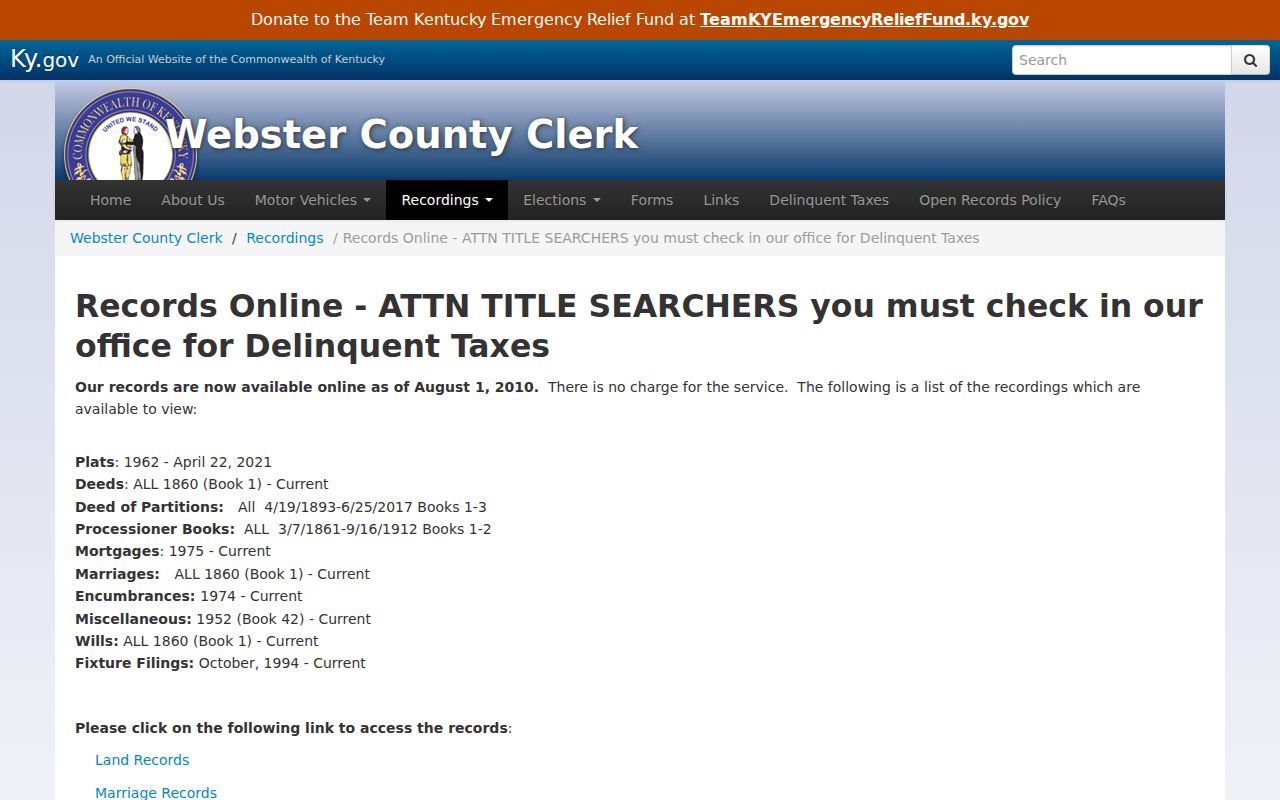
The endpoints of these series vary widely. Backscan work continues, the clerk cautions, so a coverage label is no guarantee that every image has been posted.
Processioners Extend Webster County History
Processioner books are a distinctive Webster County source. They preserve boundary-line work from 1861 through 1912, long before modern parcel polygons existed. For an old farm, set a processioner reference beside partition deeds and the first county deed. Add later plats and the present GIS outline too.
A creek may bridge generations better than the address. So can a vanished road, an adjoining owner, a coal reservation, or a farm name. The modern map frames the question. A disputed legal line needs a surveyor or a court.
Follow Webster County Parcel Splits
Owners can vanish when a parent tract is divided. Lots can also be joined. Capture predecessor and successor parcel IDs when known. Then search the deed or plat that explains the change. The clerk’s plat series begins in 1962 and runs through April 22, 2021. Older divisions may live instead in deed descriptions or partition records.
Addresses get renumbered, and routes gain local street names. A postal city can differ from the incorporated boundary. Never swap a street address for the legal description. Lot, block, subdivision, acreage, calls, and source of title keep the chain tied to the land itself. They tie the chain to the land, not the mailing label.
Resolve Webster County Estate Transfers
A death can break a simple buyer-to-seller chain. Search the will series first. Add the probate case, affidavit of descent, inheritance-tax lien or release, and the later deed. The clerk lists wills from 1860 Book 1 through current, plus a posted affidavit-of-descent recording category.
Death certificates are separate. KRS 213.131 restricts inspection and makes death records public after fifty years. A certificate may support identity research. It does not convey land. The recorded estate or court instrument is the link that belongs in the previous-owner timeline.
Request Older Webster County Owners
The Webster County Clerk takes requests by phone at 270-639-7006 and in person at the recording counter, 25 US Highway 41-A South in Dixon, weekdays from 8:00 a.m. to 4:00 p.m. Bring or recite the parcel ID, the exact party name variants, book and page, the legal description, and a bounded date range. Ask, too, which material sits in the office but not online.
A written request can go in under the Kentucky Open Records Act by email, mail, fax, or hand delivery. County policy allows five business days for a response and charges fifty cents per page for general copies. KDLA accepts research requests as well, billing base, copy, and postage charges separately.
Need one instrument rather than the whole backward chain? The Webster County deed records resource is the better starting point.
Set Limits on Webster County History
A reconstructed chain has limits. A missing release does not prove a debt still stands. An indexed court case does not prove its outcome. One old tax roll can tie a name to land for a single year without showing the full title interest. So label every item you rely on as a recorded instrument, an assessed field, GIS geometry, a historical archive, or a known gap. That discipline keeps Webster County property records work honest. It also keeps conclusions from drifting past what the documents support.
Previous-owner research serves real purposes: house history, estate files, boundary disputes, and purchase diligence. Use the least personal information the task requires. That matters especially once the chain of title reaches living owners of record.
Respect the record. A deed chain is not a title opinion. Never use former-owner details to track, harass, intimidate, or harm a person.